
You have no items in your shopping cart.

2026 Best Bluetooth Smart Glasses for Global Buyers?
Bluetooth Smart Glasses are moving from experimental gadgets toward practical tools for calls, navigation, translation, and hands-free work. Yet the category remains difficult to measure. Definitions differ between Bluetooth audio glasses, camera glasses, and augmented-reality eyewear. That uncertainty deserves attention.
The Bluetooth SIG’s 2024 Market Update forecasts annual Bluetooth device shipments to rise from approximately 5.4 billion in 2024 to 7.3 billion by 2028. Its report also identifies growing demand for connected personal devices. Grand View Research estimates that the global smart glasses market reached about US$1.9 billion in 2023, with strong growth expected through 2030. These figures are useful, but not perfectly comparable. The market still lacks one universal product definition.
Hugo Swart, a respected XR industry executive, has described extended reality as “the next computing platform.” That view helps explain the appeal of Bluetooth Smart Glasses. They can place a microphone near the mouth, speakers beside the ears, and controls on a small temple-mounted button. For global buyers, however, comfort may matter more than headline features. Battery life, Bluetooth codec support, language compatibility, privacy controls, repair access, and regional warranty terms can change the ownership experience. A beautiful frame is not enough. The best model for a commuter in London may disappoint a field worker in Jakarta. Testing methods also vary, and advertised battery figures often assume light usage. This guide compares the leading options with that limitation in mind, using published data, practical user needs, and a cautious view of fast-changing specifications.
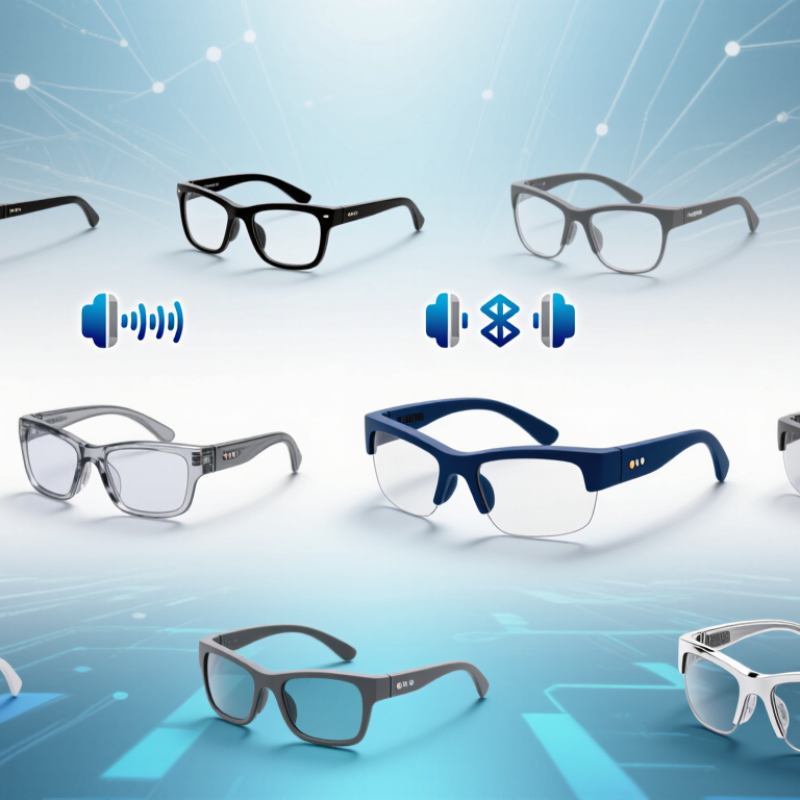
Table of Contents [Hide]
What Are Bluetooth Smart Glasses and How Do They Work?
Bluetooth smart glasses are wearable frames with built-in Bluetooth, speakers, microphones, and a small battery. They connect to a smartphone for calls, audio, navigation prompts, and voice controls. Some models also include cameras or display systems, but Bluetooth alone does not create visual overlays. It mainly carries sound and control data between devices. During a practical check, confirm pairing stability, microphone clarity, speaker volume, and battery performance in real conditions. A quiet room can hide problems that appear beside traffic or strong wind.
The glasses usually pair through a mobile application. After connection, the phone processes most commands and sends audio back to the frames. This design keeps the glasses lighter, but it depends on the phone’s battery, software, and connection quality. Delayed audio may occur in crowded wireless environments. Comfort also matters: heavy temples can cause pressure after several hours. Check lens options, charging methods, water resistance, warranty terms, and supported languages before buying internationally. I once assumed a longer battery rating meant better value, but charging speed and daily comfort mattered more.
Tips: Test the microphone outdoors. Keep volume moderate. Read independent reviews and technical specifications together. Check regional compatibility, return policies, and data settings. Avoid wearing them where recording could disturb others. Privacy expectations vary, and responsible use remains important.
2026 Best Bluetooth Smart Glasses for Global Buyers? – What Are Bluetooth Smart Glasses and How Do They Work?
Bluetooth smart glasses are wearable devices that connect wirelessly to a smartphone or another compatible device. They commonly combine open-ear audio, microphones, voice controls, sensors, and optional cameras or display functions. The comparison below focuses on practical buying criteria rather than company or brand names.
| Buyer Priority | Recommended Smart-Glasses Type | Typical Bluetooth Function | Typical Battery Runtime | Key Hardware | Advantages | Important Limitations | Global-Buyer Suitability |
|---|---|---|---|---|---|---|---|
| Everyday calls and music | Open-ear audio glasses | Bluetooth Classic or Bluetooth 5.x audio connection; usually supports hands-free calling and media playback | Approximately 4–10 hours of active use; charging cases may provide additional charges | Directional speakers, dual microphones, physical controls, rechargeable battery | Hands remain free; ears stay open to surrounding sounds; suitable for commuting and daily wear | Audio leakage may be noticeable in quiet places; sound quality is usually below that of sealed headphones | Suitable for most regions and phone platforms |
| Hands-free voice assistance | Voice-enabled smart glasses | Bluetooth links the glasses to a smartphone, while the phone usually provides internet access and cloud-based voice processing | Approximately 3–8 hours of mixed use, depending on microphone and assistant activity | Microphone array, speaker system, touch or button controls, companion mobile application | Convenient voice commands, reminders, calls, navigation prompts, and message handling | Many advanced voice features depend on a smartphone, data connection, supported language, and regional service availability | Check language, app, and service support before purchase |
| Photography and short video | Camera-equipped smart glasses | Bluetooth handles controls, notifications, and some audio functions; Wi-Fi or a wired connection may be used for large media transfers | Approximately 2–6 hours of mixed use; continuous recording reduces runtime | Wide-angle camera, microphones, LED recording indicator, internal storage or phone storage access | Quick first-person photos and video without holding a phone | Image quality depends on lighting and stabilization; privacy, recording laws, and airline or venue rules vary by country | Review local privacy and recording regulations |
| Navigation and outdoor activities | Sports-oriented audio glasses | Bluetooth audio connection for navigation prompts, calls, and music; GPS is commonly supplied by the paired smartphone | Approximately 5–12 hours of playback, depending on volume and environmental conditions | Lightweight frame, open-ear speakers, wind-resistant microphones, sweat-resistant enclosure | Useful for walking, cycling, running, and travel while maintaining environmental awareness | Wind can reduce microphone performance; most models do not replace certified protective eyewear | Confirm impact protection and weather rating if required |
| Workplace translation and remote support | Enterprise-connected smart glasses | Bluetooth may provide audio and control links, while Wi-Fi or a smartphone network supports remote applications | Approximately 3–8 hours, depending on camera, display, and network use | Camera, microphones, speaker or display module, motion sensors, enterprise software support | Can support guided workflows, remote assistance, inspection, and hands-free information access | Higher cost, heavier software dependence, device-management requirements, and possible data-security concerns | Best when technical support and compatible software are available |
| Visual notifications and augmented information | Display-enabled smart glasses | Bluetooth may connect to the phone for controls and notifications; some models also use Wi-Fi for content and cloud services | Approximately 2–6 hours when the display is frequently active | Micro-display or optical projector, motion sensors, speakers, microphones, companion application | Can show selected notifications, directions, captions, or contextual information without looking at a phone | Limited field of view, brightness constraints outdoors, higher power consumption, and possible prescription-lens restrictions | Verify display language, regional applications, and lens compatibility |
| Prescription eyewear users | Prescription-compatible smart glasses | Bluetooth features are generally the same as those of the corresponding audio, camera, or display category | Usually similar to the base product; lens type normally has little effect on battery life | Replaceable or custom prescription lenses, adjustable nose pads, electronic frame components | Combines vision correction and smart functions in one wearable device | Not every prescription range, lens thickness, tint, or progressive-lens design is supported | Obtain exact prescription limits and local fitting support |
| International travel | Compact travel smart glasses | Bluetooth pairing with a phone for audio, calls, controls, and selected translation or navigation features | Approximately 4–10 hours; charging case or USB charging is commonly required for multi-day travel | Foldable frame, USB charging, microphones, open-ear speakers, low-power wireless chipset | Reduces the need to carry separate earbuds for calls and basic audio | Bluetooth performance can be affected by crowded radio environments; advanced services may require roaming data | Check charger compatibility, app availability, and warranty coverage |
How Bluetooth smart glasses work: the glasses use a low-power wireless chipset to pair with a smartphone, tablet, or computer. Bluetooth carries audio, call data, control commands, and device status. The paired phone commonly supplies internet access, GPS, applications, and cloud services. A rechargeable battery powers the speakers, microphones, sensors, camera, and optional display. Actual runtime varies with volume, recording, display brightness, temperature, network activity, and software features.